
Executive Summary: Long before it meant “open to swapping partners,” the pineapple was a symbol of welcome and luxury. Colonial mariners brought pineapples home as a rare fruit, and innkeepers hung pineapple signs to signal hospitality. Fast-forward to the late 20th century: casual references in dating profiles and party lore morphed the pineapple into a subtle swingers’ signal. By the 2000s, forums and Urban Dictionary entries linked the upside-down pineapple to partner-swapping parties. Today, cruise passengers and partygoers discreetly display pineapple motifs – on jewelry, door decorations or even in shopping carts – as a nod to the lifestyle. But context matters: pineapple motifs are still common décor and fashion, and assumptions can misfire. This post traces the pineapple’s journey from colonial décor to swingers’ code, explains why it “works” as a signal, notes its many guises (right-side-up vs inverted, emoji, décor, jewelry) and cautions about misunderstandings. We’ll also list shops that sell pineapple-themed jewelry and décor (note whether they explicitly court the swinger crowd or not).
The pineapple’s connection to hospitality dates back centuries. When European sailors first encountered pineapples in the Caribbean (Columbus’s second voyage in 1493), they noted locals hung the fruit outside huts as a gesture of welcome. The rich in Europe prized pineapples as exotic status symbols, renting or gifting them at lavish parties. In colonial America, this translated into visible décor: innkeepers and homeowners carved pineapple motifs into gateposts or signs to let travelers know “visitors are welcome”. By the 1700–1800s, a pineapple carving or center-piece in the parlor was a standard welcome sign, denoting warmth, friendship and top-quality hospitality. (Today many hotels and B&Bs still display pineapples as a nod to that tradition.)
These “Friendship Fruit” roots are why we still see pineapples on home décor and gifts. In fact, one modern Charleston jewelry store notes: “Though the Pineapple does not grow here…, it has been a symbol around Charleston for centuries. Known as the symbol for southern hospitality… it makes a great gift for someone you love!”. In short: pineapple = welcome in the broad cultural psyche.
The leap from “welcome” to “swinger signal” is surprisingly recent. The association has been pieced together from lifestyle lore, cruise-ship subcultures and online chatter:
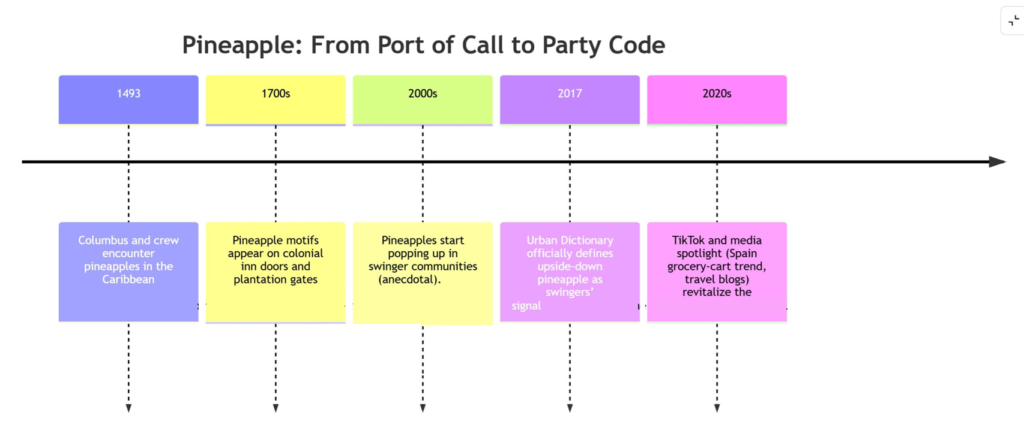
The early 2000s seem to be when the pineapple code gestated among swinger circles. Forum chatter suggests couples at adult-themed resorts or online groups joked about using a pineapple in one’s luggage or shopping cart to signal interest. In fact, the first urban-dictionary entry referencing “upside-down pineapple” appeared in 2006 (albeit oddly as a slang for an oral sex act). It wasn’t until 2017 that Urban Dictionary got an entry specifically linking the upside-down pineapple to swinger parties.
During the 2010s, tech and travel media caught on. Cruise bloggers and lifestyle sites began explicitly explaining the symbol. A 2025 PointsGuy article notes: “For people who are swingers… upside-down pineapples serve as a subtle way to indicate they’re part of that lifestyle” on cruise ships or tropical getaways. Multiple travel guides now warn cruisers that an upside-down pineapple on a cabin door “conveys a very specific message” – albeit with disclaimers that context matters.
The gist: the pineapple went from ancient welcome mat to a modern covert call sign. The exact origin in swinger lore is murky (dates and first-users are largely unrecorded), but by the mid-2000s it was firmly part of the inside-joke codebook. Today you might see the trend mentioned in hookup app profiles or party invitations with wink: take that pineapple!
Why did swingers zero in on the pineapple? Several factors:
Visual appeal: Pineapples are colorful, fun and distinctly tropical. They can be worn or displayed in many forms (pendants, prints, décor) without looking overtly “kinky.” This versatility makes the symbol easy to incorporate in casual or fancy settings.
Hospitality heritage: Because pineapples already meant “you’re welcome here,” twisting it into “you’re welcomed intimately” is a playful extension. The symbol’s existing connotation of openness and generosity provides a sort of ironic cover story.
Plausible deniability: If spotted with pineapple swag, one can always claim love of tropical fruit or décor. An upside-down pineapple on a motel door could be “just decoration” or even an homage to holiday décor (it is used in Hawaiian and southern hospitality contexts too). This allows couples to communicate discreetly. As one swinger told Men’s Health, “if there is a pineapple available, they will make use of it” – even tossing one upside-down in a shopping cart got attention.
Modern memes & tech: Modern memes and digital culture have made it easier than ever for symbols to circulate. Today, some swinger-friendly profiles subtly drop emojis like the pineapple 🍍 or the key 🔑 as coded cues. (The key, of course, alludes to the tradition of “key parties.”) As one article explains, on dating platforms, certain users adopt the pineapple emoji as a discreet way to signal their lifestyle to others. The symbol has become so iconic that it now appears everywhere—from wine glasses and nail art to swimsuits and even vacation tattoos.
Because pineapple motifs are so trendy, false positives happen. A floral Hawaiian shirt or pineapple-printed bikini more likely means “I love summer” than “we swing.” As travel writer Ashley Kosciolek advises: context is key. On cruise lines sailing from the South or Hawaii, pineapple patterns are just hospitality clichés. One PointsGuy guide warns that “pina-colada people can just mean they liked the look of the shirt,” not necessarily that they want a 4-some.
Even among swingers, etiquette dictates caution. Pineapple alone is not an invitation – it merely signals openness to conversation. Never assume consent or make direct moves just because you notice a pineapple charm. The symbol’s ambiguity means respectful communication is essential. One lifestyle expert suggests a playful approach: if you see a sign (white rocks, anklet or pineapple), it’s okay to ask light-heartedly (“Hey, love your pineapple! Is it a welcome sign?”). Their reaction will clarify if you’re among like-minded folks. If they act puzzled, smoothly back off and enjoy the décor!
In short: Double-check. Pineapples abound in fashion and décor beyond swinger circles, so avoid leaping to conclusions. Use it as an ice-breaker, not a ticket to a party. And of course, full verbal consent is the only way forward once you actually connect.
The pineapple-to-swinger link illustrates how symbols evolve. A fruit that once signified royal feasts and colonial opulence is now reclaimed by a sex-positive community to signal freedom and welcome. This repurposing is largely benign fun, but it also raises points worth noting:
Respect and consent: Behind the jokes, swinging is about mutual pleasure and trust. The pineapple symbol relies on that. Without clear communication, even “insider” cues are pointless. Ethically, one should never use hidden codes as a substitute for honest consent.
Avoid stigma: Swinging remains taboo for some. The pineapple code gives discreet cover, but it also means many people inadvertently wear the symbol without knowing its meaning. It’s often wiser not to “out” someone. In a lifestyle focused on respect, assuming everyone wearing pineapples is a swinger can be as uncool as assuming anything else from appearance alone.
Cultural roots: Some have noted pineapple symbolism has colonial baggage (wealth, exoticism). Today’s playful use is far removed from that. But it’s good to remember the broader history, especially since pineapple décor still enjoys popularity unrelated to any swinger context.
Ultimately, the upside-down pineapple is an insider wink—part fun, part practicality. Like any code, it works best when everyone handles it with good humor and good manners.
This pineapple boutique celebrate playful, stylish designs inspired by the iconic upside-down pineapple symbol. From shirts and necklaces to stickers, bottles, and even cooking accessories, each item blends creativity with a subtle wink for those in the know. Whether it’s about expressing personality, sparking conversation, or simply embracing a fun, tropical aesthetic, the collection offers unique pieces designed to stand out—both in everyday life and on vacation.